This post covers the history of recreation on the Anacostia River in DC: the dredging that created Anacostia Park, the four historic boat clubs, the swimming holes, Langston Golf Course, the Riverwalk Trail, and the groups cleaning the river today.
For most of the twentieth century the Anacostia was Washington's industrial river: the Navy Yard, gas works, coal wharves, brewery traffic, landfills, and the city's sewer outfalls were all on it. Swimming in it was banned in 1971. The people who used the river for recreation were the people who lived along it, including Washingtonians shut out of the city's segregated facilities.
The sailing and yacht clubs of the era were closed to anyone who worked with their hands, so Washington's tradesmen built motorboat clubs on the Anacostia instead: Navy Yard machinists, brewery workers, clerks, a carpenter, a boat livery operator. The members built their own boats and their own clubhouses and put in their own marine railways.
Washingtonians also swam in the Anacostia. The Tidal Basin had a bathing beach with a high dive from 1918, for white Washingtonians only, and Congress closed the beach in 1925 rather than integrate it. The Anacostia's swimming holes had no gate, no ticket booth, and no attendant, and local names: Rutman's beach, the Coal Chute, Ant beach, Glass beach, the Gas House Wharves. Unlike the Tidal Basin beach and the city's other built facilities, the Anacostia's swimming holes were not segregated.
How dredging created Anacostia Park (1898–1919)
The land along the lower Anacostia was made by dredging. By the end of the nineteenth century the river's lower reach was a wide, shoaling expanse of tidal flats, thick with sewage, a navigation problem and a public-health problem. In 1898 Congress passed an act mandating the dredging of the Anacostia.
The McMillan Plan of 1902 proposed dredging the channel, pumping the spoil onto the flats, and building an "Anacostia Water Park" on the new ground. The firm of Sanford and Brooks began dredging in January 1903. The Army Corps of Engineers surveyed the surrounding land as the work went on, finishing in November 1905, and the federal government asserted ownership of the flats. In 1919 most of that reclaimed mud was declared parkland.
The dredging produced roughly 1,200 acres of riverfront park. The dredging also buried the tidal marshes and cut the remaining wetlands off from the tides, damage that wetland restoration projects are still repairing.
Eastern Power Boat Club, founded 1905
The first club on the river started with fishing. A group of anglers near the Navy Yard "banded together, and turned to power boating." Eastern Power Boat Club dates its founding to 1905, credited to William A. Mills, L. J. Johnston, and Monty Williams, formally organized on October 3, 1910 with twenty members, and incorporated on June 6, 1911.
Early members were Navy Yard and brewery workers, tradesmen, and servicemen, paying dues of fifty cents a month. The members built their own boats and laid their own marine railway, a cradle and track running down into the river, and the turn-of-the-century winch from that work still runs.
In June 1911, Mills won a wharf lease with a bid of $1.75 per foot. In 1912 the club leased ninety-three feet of city waterfront for $162.75 a year. From 1916 into the 1930s the club financed its own construction by issuing "Certificates of Indebtedness" to its members, repaid at six percent, because no bank would lend to a workingmen's boat club.
The club moved twice. The club sat at the foot of 11th Street SE until 1919, when the Navy Yard's wartime expansion took in the site. Members had finished a two-story frame boathouse, thirty by forty feet with a loft, in 1913, so rather than leave the boathouse behind they floated the building across the river on a scow and set it down on the east bank just east of the 11th Street Bridge. In 1924, as Anacostia Park took shape on the reclaimed land and the new roads and water service reorganized the shoreline, the club floated the same building again, to the Water Street site it has held since. The 1913 boathouse is the oldest purpose-built clubhouse still standing on Boathouse Row, and has stood in three places without being rebuilt.
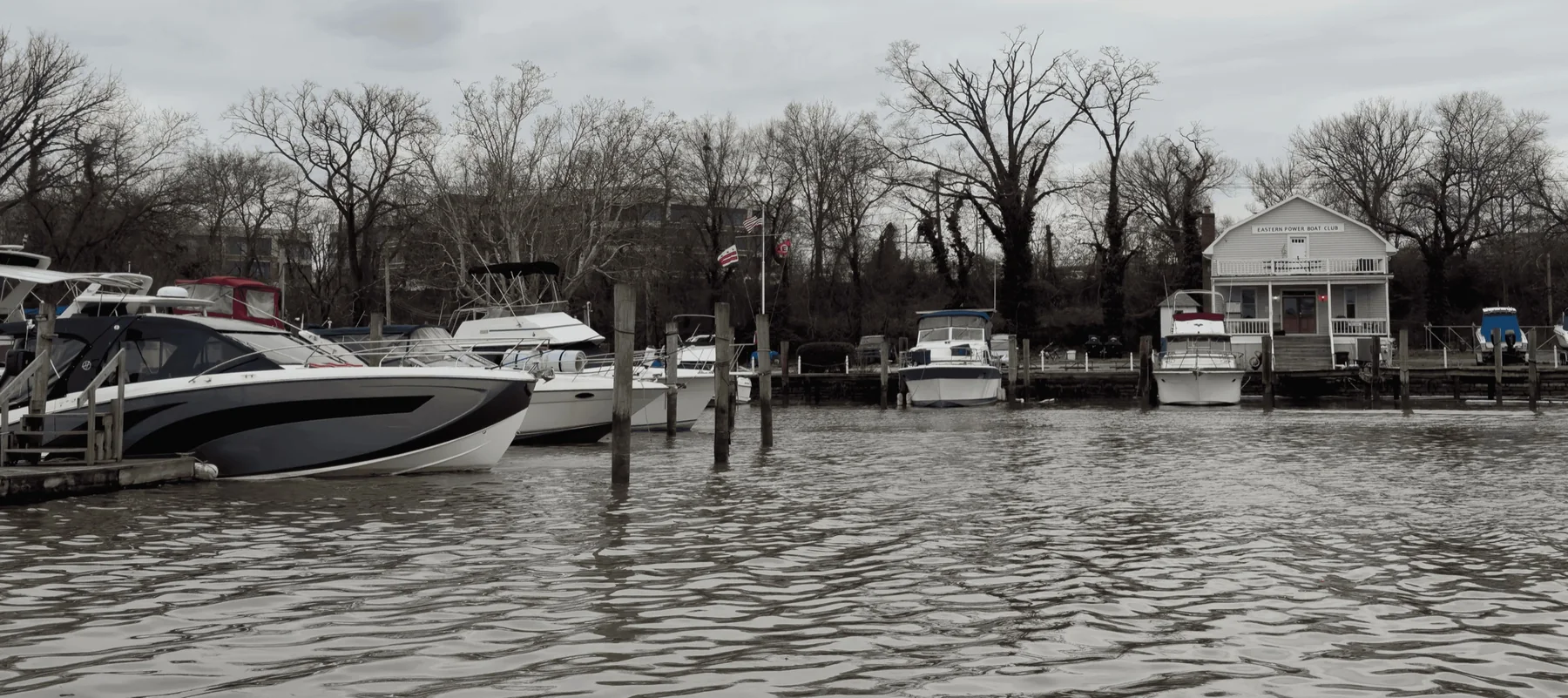
The 1913 clubhouse today, at the Water Street site it reached in 1924. Courtesy Eastern Power Boat Club.
Washington Yacht Club, founded 1910
The Washington Yacht Club was founded on April 27, 1910, by two men from Twining, the neighborhood at the east end of the Pennsylvania Avenue bridge that maps of the time labeled by that name. Samuel Masson was the club's first commodore.
The members were working-class residents of the east side of the river who wanted somewhere close and affordable to keep a motorboat: mechanics, clerks, a carpenter, a boat livery operator. The members built their own boats and their own buildings and rarely contracted out the work, a habit the club keeps as mandatory work parties today.
From 1910 to 1915 the club sat at the bottom of Naylor Road SE, leasing docks from the city on the old ferry ground below the heights, where boats had been crossing since long before there was a bridge. Around 1915, as the reclamation of the Anacostia flats reshaped that bank, the club moved a short way to the Pennsylvania Avenue bridge pier and built a clubhouse, twenty by thirty feet. In early 1925 the club towed that clubhouse across the river on a scow to 1500 M Street SE. The original frame is still the middle of the building; a steward's room went on the back in 1929 and restrooms and a galley in 1930.
For the club's first fifteen years, the dockage ran between the old Naylor ferry landing and the Pennsylvania Avenue bridge, the two crossings that had defined that side of the river for a century, so a Twining family could walk down the hill to its boat.
Club records show members reporting polluters and helping with cleanups as early as 1923. Members ran marine security patrols during the Second World War and worked the Presidents Cup races from 1926. The clubhouse was listed on the National Register on October 2, 2020.
Seafarers Yacht Club and District Yacht Club, founded 1945 and 1955
Lewis T. Green was an art teacher in DC Public Schools who built boats in his spare time. When Green went looking for dockage on the Anacostia in the 1940s, the river's clubs were segregated, as almost everything in Washington was, and none of them would take him.
Green applied for river land of his own. The application sat until Mary McLeod Bethune took it up, and with her help Green secured a lease from the Department of the Interior. In 1945 Green founded the Seafarers Yacht Club in Anacostia Park. Seafarers is the oldest African American boating club in the United States, and the club is still running.
The Anacostia's clubs are open to anyone today, and the clubs race and raft up together.
The clubhouse sits on the river north of the John Philip Sousa Bridge and just south of the CSX railroad bridge, across the water from the Anacostia Park skating pavilion. In 1965 Seafarers became the first Black boating club admitted to the American Power Boat Association. On May 2, 2022 the clubhouse was added to the National Register of Historic Places.
The Seafarers Yacht Club, founded 1945 — the oldest African American yacht club in the country, and still a working club. Photo: Ser Amantio di Nicolao, CC BY-SA 4.0.
The fourth of the historic clubs, the District Yacht Club, came together around 1950 under Ed Darnell, took over a former boatyard property about two years later, and was chartered and incorporated in 1955.
None of the four clubs has ever owned the ground. Each club owns its docks and buildings and holds the land underneath on a lease, from the federal government for most of the last century and from DC since the federal-to-DC land transfers of the late 2000s. Because the land is leased, the riverfront under the clubs is still public land.
Powerboat racing and swimming in the Anacostia
The clubs also raced. Commodore John E. Battenfield (1866–1950) ran a hydroplane called the Gray Bat that was, for a stretch in the 1920s, recognized as the fastest craft on the Atlantic Coast. Battenfield took some thirty trophies before he stopped racing in 1926. Battenfield had started out under the Corinthian Yacht Club's colors and later served as Eastern's commodore, and the boat raced on the river for years.
A sportswriter in 1925 described what happened when the Gray Bat came down the Eastern Branch: children at the swimming holes would "beat it for deep water" so they could ride the rollers the boat threw off as it went past. Washingtonians learned to swim off those banks, next to the gas works.
Swimming in the Anacostia was banned outright in 1971. Decades of stormwater and sewage, industrial runoff, landfills, and the oil and gas works along the banks had made the river unswimmable. Washington Yacht Club members had been reporting polluters since 1923, and the cleanup since 1971 has been the work of volunteer organizations like the clubs. The ban is still in force, and groups listed below are working to lift it.
New Deal projects in Anacostia Park: the pool and Langston Golf Course
Anacostia Park got its facilities in the 1930s, after Franklin Roosevelt put the Capital Parks system under the National Park Service in 1933 and New Deal money followed.
The Public Works Administration put up $69,036 in 1936 for a swimming pool in Anacostia Park, roughly $1.3 million in today's money. The BZ Contracting Company built the pool and finished in early 1937, and the pool was reported to hold about five hundred swimmers.
The pool was segregated. When National Capital Parks moved to desegregate the pool in June 1949, the Black children who showed up to swim were harassed out of the water, and the disorder ran for days before the pool was closed.
In 1939, Langston Golf Course opened along the eastern shore of the river inside the park, roughly 145 acres, named for John Mercer Langston, the first Black congressman from Virginia.
Helen Webb Harris founded the Wake-Robin Golf Club in 1937, the first Black women's golf club in the country, and the club immediately began petitioning for public courses open to Black golfers. In 1938 Interior Secretary Harold Ickes approved construction of the nine holes that became Langston. The course went on to host politicians, celebrities, and touring professionals, and Wake-Robin, still the oldest Black women's golf club in the nation, still plays there. Langston was listed on the National Register of Historic Places in 1991.
Today Langston is an eighteen-hole course with a driving range, open to anyone who books a tee time, at the north end of the park.
The Anacostia Riverwalk Trail
The Anacostia Riverwalk Trail, begun in 2004, connected the park's separate sections, which before the trail had to be reached one at a time by car.
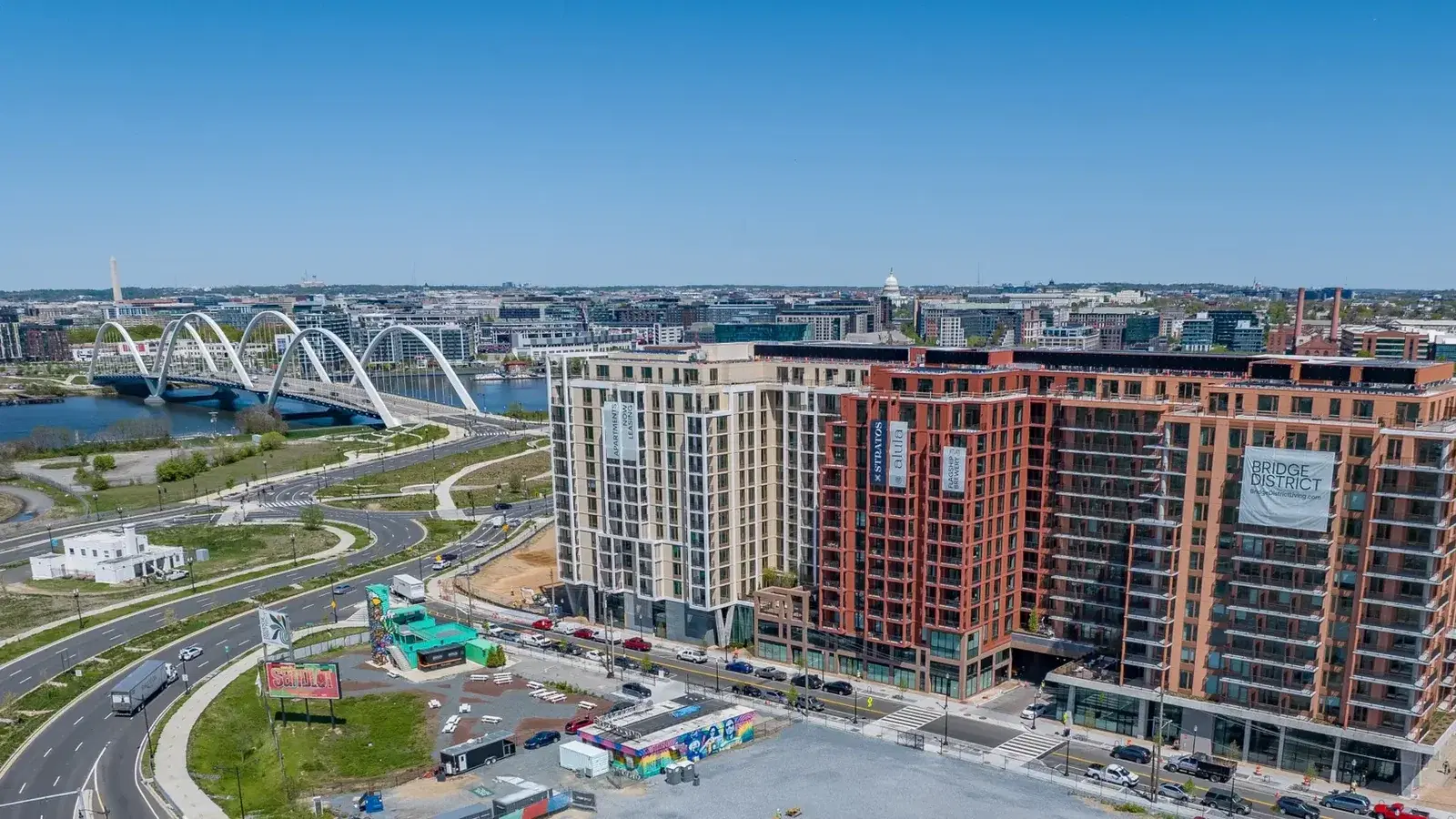
The trail runs along both banks of the river, roughly twenty miles inside DC alone, part of a network planned at twenty-eight, linking Nationals Park and the Navy Yard to Historic Anacostia, the boat clubs, Anacostia Park, RFK, Kenilworth, and the National Arboretum. Starting in fall 2009, two bridges went in just north of the Sousa Bridge, one on each bank, carrying walkers and cyclists over the CSX tracks that had cut the neighborhoods off from their own waterfront.
From Fairlawn or Hill East, the trail bridges reach the rink, the pool, the golf course, and the marinas on foot or by bike without crossing the railroad.
Anacostia Park today: roller rink, marinas, and ballfields
The roller skating pavilion in Anacostia Park is the only roller rink in an American national park, about 3,300 square feet of open-air floor under a roof that keeps off sun and rain. Skating is free, and when the rink is open you can borrow skates for nothing.
Alongside the rink: a public boat ramp and three concession-run marinas next to the four club docks, ballfields, basketball and tennis courts, and picnic pavilions strung out along the water for a mile, all of it on the land created by the 1903–1905 dredging.
Rowing and paddling clubs on the Anacostia
The Anacostia Community Boathouse Association is a coalition of member organizations sharing one boathouse on the river: Capital Rowing Club, DC Strokes, American University's crew, Gonzaga, Bishop Ireton, Wakefield, the Anacostia Watershed Society, and the National Capital Area Women's Paddling Association among them. In 2024 those clubs counted close to 1,100 members and well over 2,000 organized practices.
DC Strokes has been rowing on the Anacostia since 1991 and is the oldest LGBTQ+ rowing club in the country.
Sailing is on the Washington Channel rather than the Anacostia: DC Sail, the community sailing program of the National Maritime Heritage Foundation, runs lessons, rentals, racing, and youth programs from The Wharf, around the point from the Anacostia.
Groups cleaning the Anacostia River
The organizations working to lift the 1971 swimming ban are local and largely volunteer-run.
The Anacostia Watershed Society started in 1989. The society's stated job is to clean the water, recover the shores, and honor the heritage, and the society is also a member of the Anacostia Community Boathouse Association, so the same organization restoring the river keeps boats on it.
Anacostia Riverkeeper, founded in 2008, works the trash, the water-quality monitoring, the stormwater advocacy, and public river access. Riverkeeper's Clean Waterways program has run more than 160 volunteer cleanups since 2014, roughly fifteen a year, and pulled something on the order of 150,000 pounds of debris out of the river and its banks. Riverkeeper is also among the groups pushing to make the Anacostia legally swimmable again.
Ward 8 Woods Conservancy, founded in 2018 by Nathan Harrington, works on the land along the river. The conservancy looks after more than 500 acres of forest in Ward 8, much of it draining straight into the Anacostia, clearing decades of illegal dumping, cutting invasives, and opening trails. The conservancy employs a small crew of Park Stewards, Ward 8 residents, to do the work. Those 500-odd acres of woods have something like 1.4 miles of trail in them, while Rock Creek Park's roughly 1,750 acres have more than thirty.
DC's own trash-trap program, the rowing clubs, the watershed groups upstream, and the boat clubs also take part in the cleanup; the boat clubs have done it longest, since Washington Yacht Club members started reporting polluters in 1923.
Buying a home near the Anacostia River
District Mortgage is a DC mortgage company, and this post is part of its series on the neighborhoods where its clients buy. Fairlawn, Historic Anacostia, and Twining sit on the east bank next to Anacostia Park, and Hill East and the Navy Yard sit on the west bank; the Riverwalk Trail bridges connect Fairlawn and Hill East to the rink, the pool, the golf course, and the marinas on foot or by bike.
For a house on this side of the river, start with our Fairlawn and Historic Anacostia guides, or get pre-qualified in two minutes with no credit pull.