The Pennsylvania Avenue crossing of the Anacostia at the Sousa Bridge is one of the oldest river crossings in Washington, in use since George Washington's presidency. Each new bridge and the trolley line brought houses to the neighborhoods above the crossing: Fairlawn and the blocks old maps label Twining. This post covers that history and financing a house there today.
The Anacostia crossing from 1795 to 1890
The first bridge here, the Eastern Branch Bridge, a privately owned toll drawbridge, went up between 1795 and 1800, when the capital was newly founded. The bridge carried the road to Upper Marlboro, which is why Pennsylvania Avenue SE runs where it does today.
In August 1814 retreating American soldiers burned the bridge themselves to slow the British march on Washington. The bridge was rebuilt, served for another generation, and burned to the waterline in 1846 after a steamboat's sparks caught the draw span, and for the next forty-four years ferries carried the crossing. The ferries carried farmers, traders, and travelers over the river to the turnpike, landing below the heights where the Naylor family farmed, the family whose name still runs across the map on Naylor Road. When the campaign for a new bridge took shape in 1870, Colonel Henry Naylor was among the men leading the campaign.
In 1890 an iron girder bridge opened at the old crossing, putting the land on the far side fifteen minutes from Capitol Hill.
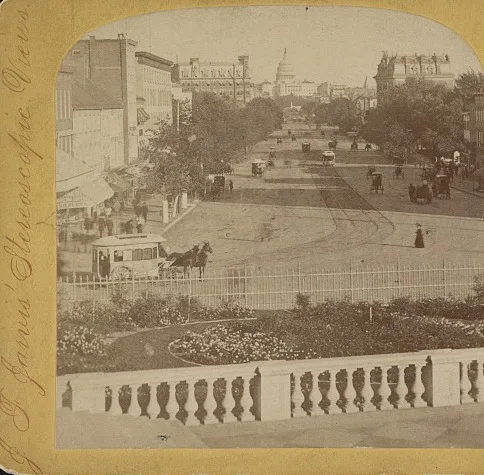
Pennsylvania Avenue in 1890, the year the iron bridge opened at the avenue's eastern end. Streetcars crossed the river by about 1908. Library of Congress.
The trolley line from 1898 to 1923
The East Washington Heights Traction Railroad was incorporated in 1898, and by 1903 its cars ran from the Capitol along Pennsylvania Avenue SE to Barney Circle. Around 1902, developer Arthur Randle, the same Colonel Randle who built Congress Heights and Randle Highlands, won approval from Congress to lay tracks across the bridge itself, and by about 1908 the trolley was climbing the far bank, running out Pennsylvania Avenue to 27th Street SE.
Houses were built along the trolley line. The first homes in old Twining went up in 1905, and most of the houses on those blocks date from the 1910s: two-story wood-frame Italianates with bracketed cornices and tall windows at cottage scale, in the triangle between Pennsylvania and Minnesota Avenues.
Twining is named for Major William Johnson Twining, the Army engineer who served as DC's Engineer Commissioner from 1878 until 1882. By 1917 the trolley reached past 33rd Street; in 1923 buses took over the route, and today's D10 and D1X Metrobus routes follow the trolley's path down Pennsylvania Avenue.
Fairlawn, the Christie estate and Anacostia Park
Dr. Arthur Christie, a wealthy Englishman, bought roughly fifty acres above the water and named the property Fairlawn for its smooth, grassy slope running down to the Anacostia. When the land was subdivided, the estate's name became the neighborhood's. Anacostia Park runs the full length of Fairlawn's western riverfront, with the skating pavilion, ballfields, and the river trail.
Fairlawn's houses were built from 1894 through the 1940s, with the majority built between 1910 and 1930. The stock includes bungalows, American Foursquares, colonials, brick ramblers, and modest rowhouses built in pairs, so each paired house has a front yard and a side yard.
The Sousa Bridge, opened 1939–41
The 1890 iron bridge was retired at the end of the 1930s, replaced by the New Deal-era span that still carries Pennsylvania Avenue today, opened in stages between December 1939 and January 1941. The bridge is named for John Philip Sousa, the composer, who was born and raised in Southeast Washington blocks from the Marine Barracks, where he later led the Marine Band.
Mortgage options for Fairlawn and Twining houses
The age and type of the houses decide which loans fit:
- Detached and paired houses need no condo project review and have no association dues counted in your debt-to-income ratio.
- First-time buyer programs apply on qualifying purchases. FHA allows 3.5% down, and the whole down payment can be a gift from family. DC's reduced first-time buyer recordation tax (0.725% on purchases up to $777,000 for tax year 2026), DC Tax Abatement (price cap $576,000) and the homestead deduction are claimed at settlement. DC Open Doors (through DCHFA's participating lenders) and HPAP (through DHCD-certified housing counseling agencies) are also available to buyers who qualify.
- Renovation loans can finance restoring a 1910s frame Italianate. FHA 203(k) and HomeStyle loans underwrite against the home's value after the planned improvements, so the restoration does not have to come out of savings.
- Longtime owners can borrow against their equity. A cash-out refinance or home equity loan lets you use the equity in the house without selling.
Our Fairlawn financing guide covers the neighborhood's market in detail, and the Randle Highlands guide picks up across the avenue.
To buy in Fairlawn or Twining or borrow against your equity, get pre-qualified, book a 15-minute call, or contact us.