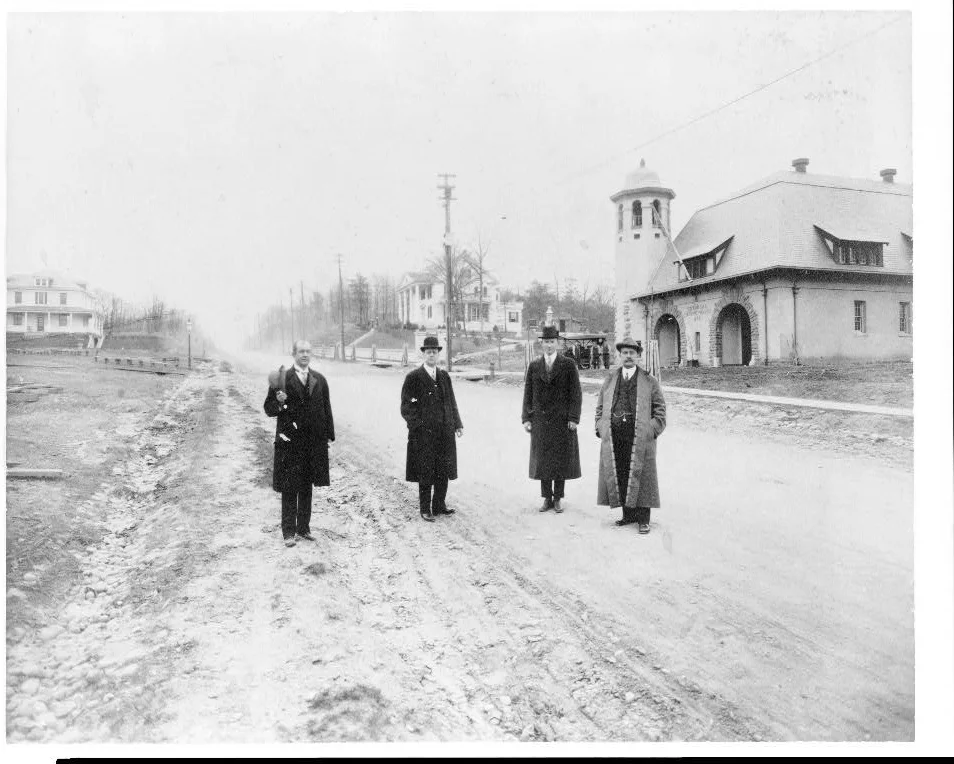
Pennsylvania Avenue SE, 1911 — developer Arthur E. Randle (among the four men pictured) standing in his still-unpaved avenue, with the firehouse he donated at right and the neighborhood's first grand houses rising behind. Library of Congress.
Colonel Arthur E. Randle (1859–1929) founded both Congress Heights (1890) and Randle Highlands (1899) in Southeast DC. Randle was a newspaper publisher who became one of the largest real estate developers in DC's history. In October 1906, The Washington Post called Randle's projects "among the largest real estate enterprises ever successfully carried through in the District."
Randle's method was to buy the high ground east of the Anacostia River before the bridges and streetcars arrived, then build the bridges and streetcars himself.
Congress Heights, founded 1890
In 1890 the land on the far bank of the Anacostia, bluffs with views back toward the Capitol, was farmland, and it was cheap because the trip downtown from there was long.
Randle founded a settlement on the bluffs and named it Congress Heights, for the view of the Capitol from its high ground. Randle then founded the Capital Railway Company and the Belt Railway to guarantee streetcar service between Congress Heights and the rest of Washington, so the transit line serving his subdivision was his own.
Congress Heights filled in with frame Victorians, brick rowhouses, and workers' cottages, many of which still stand, and within fifteen years the new neighborhood had its own amateur theater troupe.
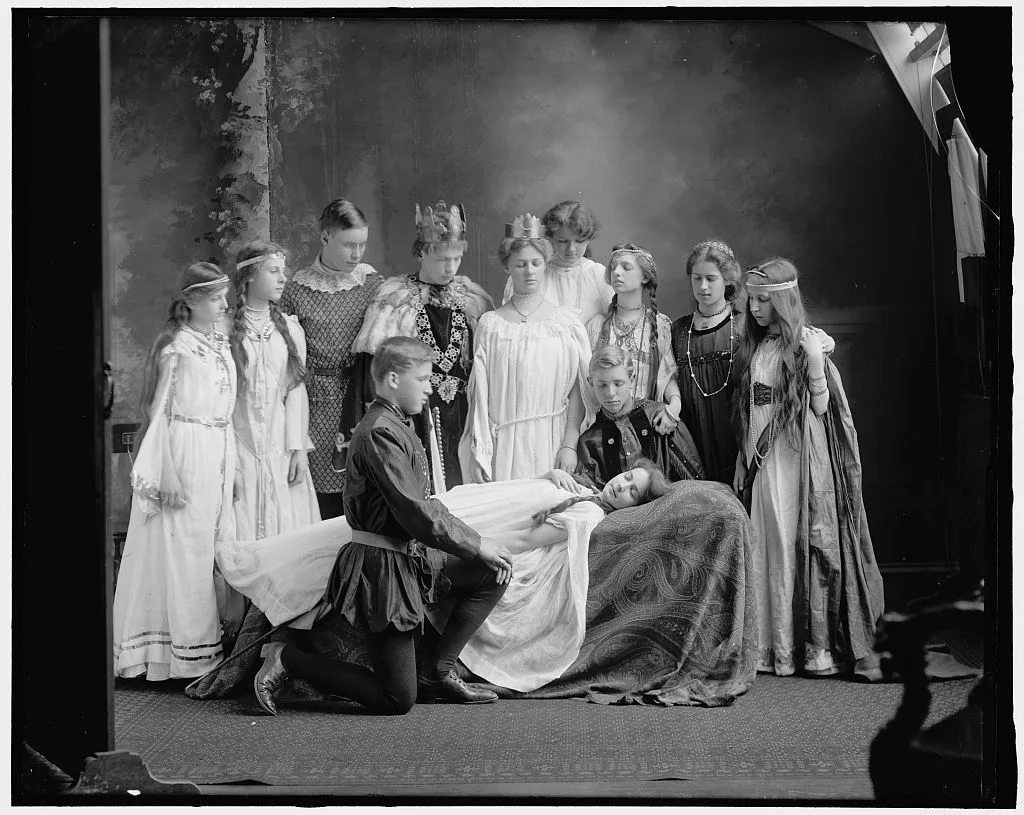
The Congress Heights Dramatic Club, photographed by Harris & Ewing in 1905 — community life in Randle's neighborhood, barely fifteen years after its founding. Library of Congress.
Randle Highlands, founded 1899
In 1899 Randle sold his interest in the Capital Railway and put the proceeds into a large tract known as "East Washington Highlands," at the foot of the Pennsylvania Avenue Bridge, the crossing known today as the John Philip Sousa Bridge.
Randle chose the tract for the bridge: Pennsylvania Avenue ran straight from the Capitol, across the river, and up Randle's hillside. Randle platted the tract under his own name, Randle Highlands, and sold lots on the high ground with views of the city and a direct route downtown.
Randle's follow-on development, "North Randle Highlands," became the land now known as Dupont Park, Penn Branch, and the lower portion of Greenway. Randle is also credited with a hand in developing Hillcrest and Shipley Terrace. Hillcrest was already known before Randle arrived: in the 1890s a resort hotel called the Overlook Inn brought Washington's wealthy families up these heights by coach.
The "Southeast White House" at 2909 Pennsylvania Avenue SE
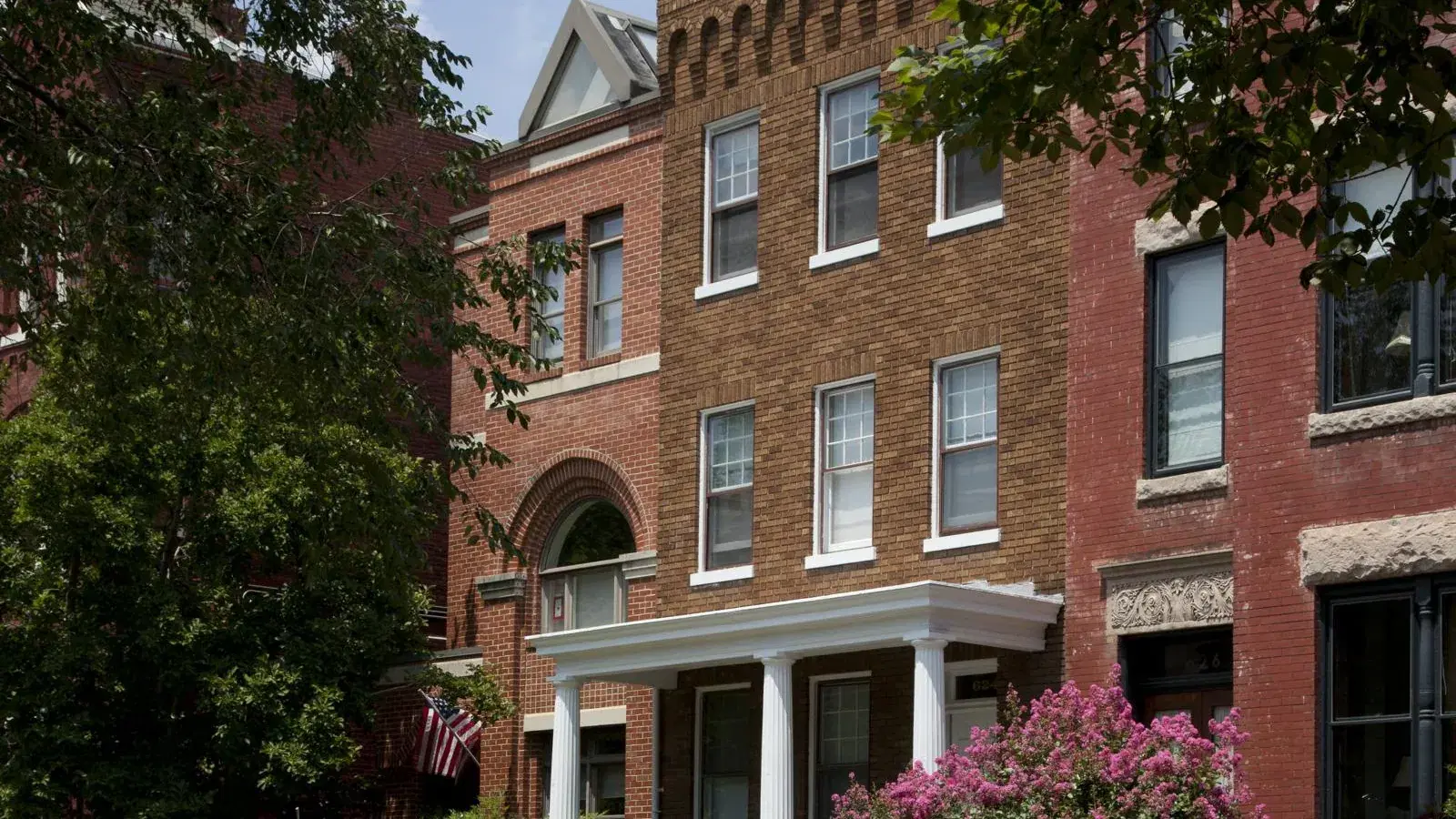
Randle built himself a Greek Revival mansion at 2909 Pennsylvania Avenue SE, which Washingtonians nicknamed the "Southeast White House," and the house still stands. Randle also used the mansion to market the neighborhood: Randle wanted Pennsylvania Avenue east of the river lined with mansions, and he campaigned openly for the city's prominent families to build grand homes along the avenue. The large foursquares and columned houses on the avenue's high ground date from that campaign.
Randle also supplied the neighborhood's institutions. Randle established Randle Highlands School, whose 1911 building still stands at 30th Street SE, and donated the land for the Chemical Company No. 2 firehouse at 2813 Pennsylvania Avenue SE, still a working DC firehouse more than a century later. By one accounting, Randle gave DC enough street mileage across his developments to pave a road from Washington to Baltimore.
Randle's later years and death
Randle left the development business and spent his later years between his Washington home and a country estate in Glenn Dale, Maryland, just over the Prince George's County line.
Randle died on July 20, 1929, at age seventy, and was buried in Congressional Cemetery, on the west bank of the Anacostia at the approach to the Pennsylvania Avenue crossing, within sight of the bridge he built his neighborhoods around.
Racial covenants in Randle's subdivisions
Like other Washington subdivisions of that era, Randle's developments were originally marketed and sold on racially exclusionary terms, a practice that was widespread in early-twentieth-century American real estate. Courts ruled such restrictions unenforceable in 1948, and fair housing law has prohibited them for more than half a century. The neighborhoods' history since is told by institutions like the Anacostia Community Museum.
Housing and home loans in Randle Highlands and Congress Heights today
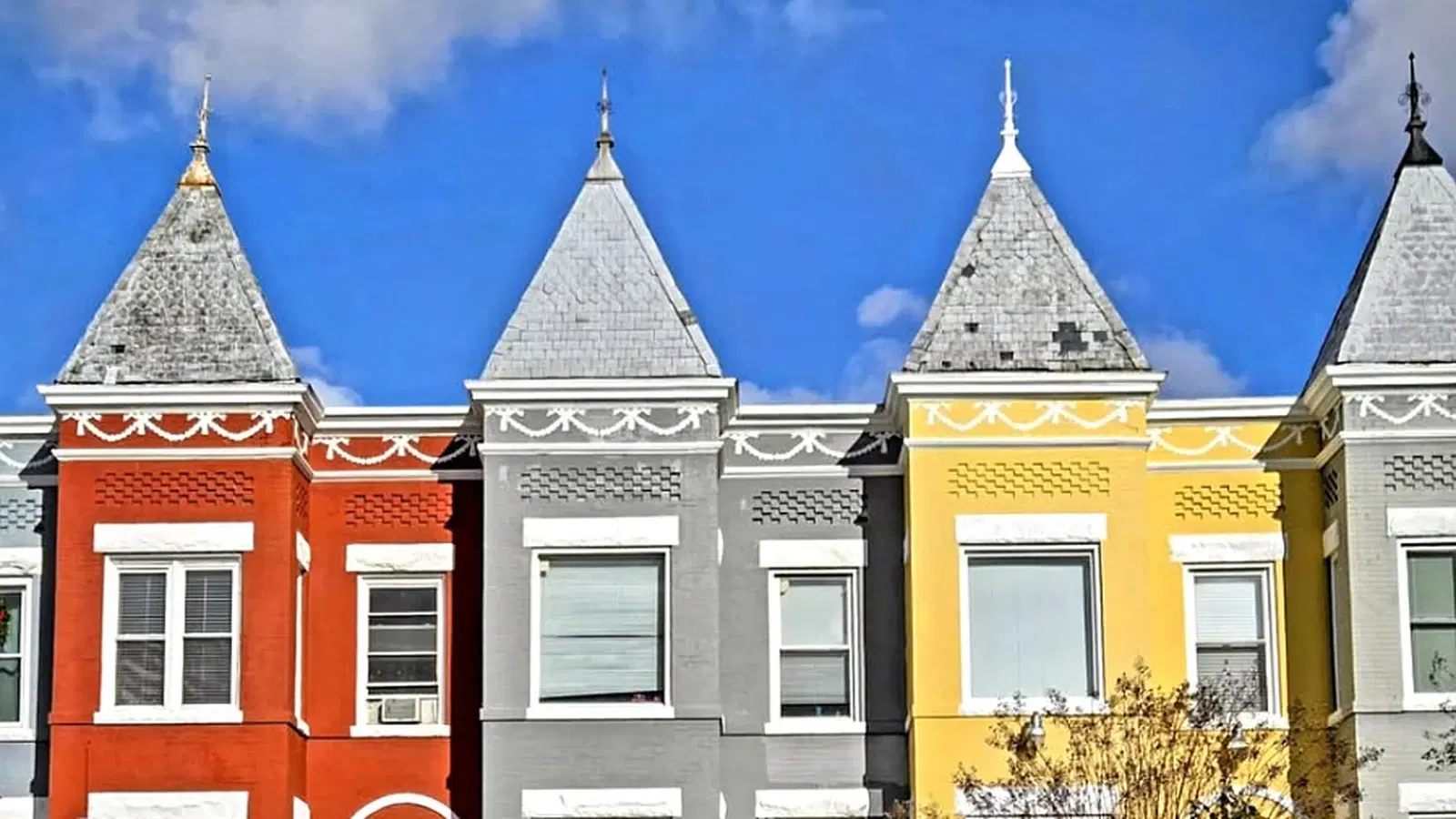
Randle Highlands today is the streetcar suburb Randle laid out: American Foursquares with deep porches, bungalows, brick colonials, and semi-detached pairs on lots that are generous by DC standards. Congress Heights kept its own mix: detached frame houses, porch-front rows, and the commercial spine along Martin Luther King Jr. Avenue.
That housing stock affects the loan in four ways:
- FHA fits these houses. FHA takes 3.5% down, the whole down payment can be a gift from family, and a detached house or rowhouse on its own lot needs no building approval.
- Detached houses need no condo project review and carry no association dues in your qualifying ratios. The lender reviews only you and the house.
- Renovation loans cover work on a century-old house. FHA 203(k) and Fannie Mae HomeStyle renovation loans underwrite against the home's value after the planned improvements, so the renovation does not have to come out of savings.
- Median prices in both neighborhoods are under DC's tax-benefit price caps. Median house prices in both neighborhoods (about $435,000 and $470,000 in recorded sales through August 2026) are under DC's first-time-buyer reduced-recordation cap ($777,000 for tax year 2026) and under the Tax Abatement purchase cap ($576,000 for tax year 2026). Income limits also apply, and both caps reset each October 1.
If you already own a house in Randle Highlands or Congress Heights and have paid down the mortgage, a cash-out refinance or home equity loan lets you borrow against the equity without selling.
Home loan guides for Randle Highlands and Congress Heights
District Mortgage keeps financing guides for both of Randle's neighborhoods:
- Randle Highlands home loans — foursquares, bungalows, renovation lending, and equity options
- Congress Heights home loans — detached houses, rowhouses, and how FHA and DC's first-time buyer programs apply at these prices
To buy east of the river or use the equity in a house you already own, get pre-qualified, contact District Mortgage, or book a 15-minute call.